Shopify customers on a map
August 23, 2026 by Michael
Shopify tells you which countries and cities your orders come from, but it shows them as tables and numbers. We wanted to actually see our customers – so we put them on a map.
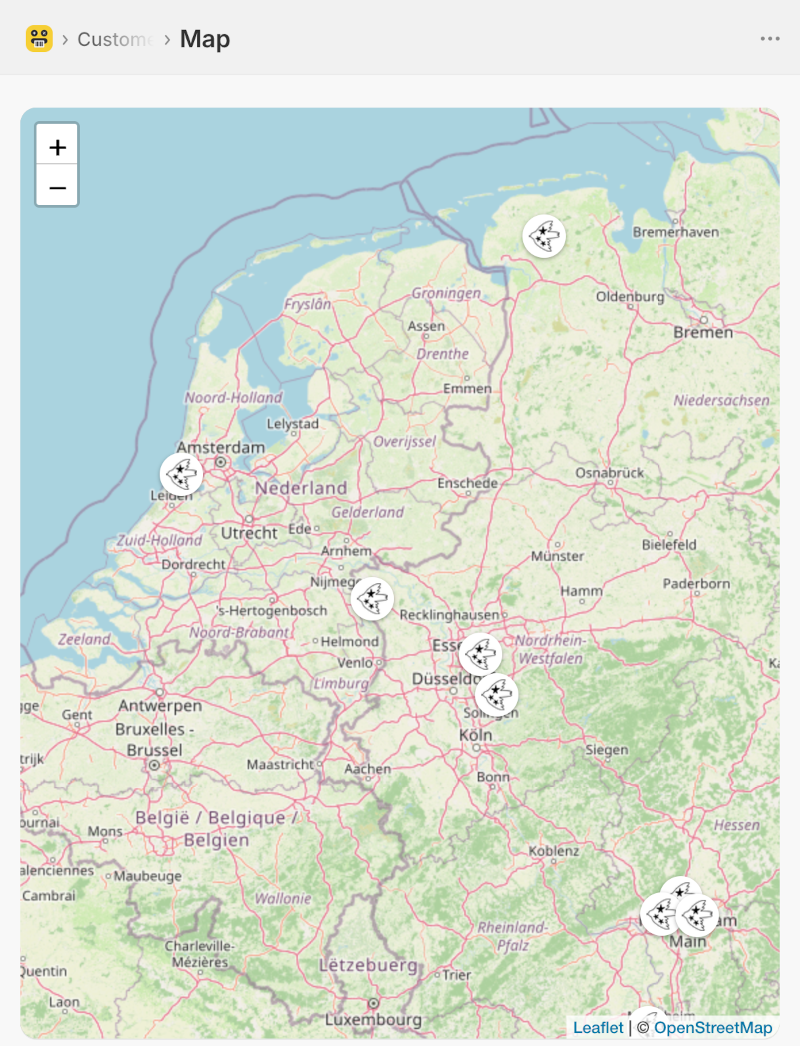
Open the Customers page and click Map. Every dot is a postal code where at least one of your orders was delivered. Click a dot and you'll see the city, ZIP code, and country. The map is powered by OpenStreetMap data: we resolve your customers' postal codes to coordinates automatically in the background, so the map fills itself in – no setup, no spreadsheets.
There's a small personal touch, too: when your shop has a logo, we use it as the marker for every customer location. It's your brand spreading across the map – and honestly, it's very satisfying to watch new logos appear as orders get delivered.
We only plot customers with at least one delivered, non-cancelled order. A cancelled test order or a fraud attempt doesn't belong on a picture of your real audience. And it stays privacy-friendly: everything works at postal-code level, never exact addresses, and customers redacted through Shopify's GDPR flow are excluded completely.
So what do you do with it?
For us, the map answered questions we had been guessing at for years:
- Where to spend on ads. Regional targeting in Meta and Google is only as good as your knowledge of where buyers actually are. The clusters on the map are your proven markets; the empty areas are either untapped or simply not your audience.
- Which delivery options to offer. Here in Poland, seeing customers cluster around smaller towns confirmed why parcel lockers beat courier delivery for us. If your dots concentrate somewhere your carrier is weak, that's a churn source you can fix.
- Where to show up in person. Pop-ups, markets, fairs – pick the city where the dots are dense, not the one that just feels right.
- Whether a new market is real. A slowly growing cluster across a border is an early signal worth acting on, long before it stands out in a revenue report.
There is also a smaller version of the same map on each customer's profile, so when someone writes to you, one glance shows where their orders travel to.
We built this because we kept zooming into courier tracking pages trying to imagine our customer base. Now the whole picture is one click away.